In 2021, a 3-year-old girl died of starvation in Gumi after being abandoned by her mother. Months later, DNA tests revealed a shocking family secret

Few cases unravel so completely that even the most basic questions — who was the victim and what was their relation to the perpetrator — become mysteries.
In 2021, a 3-year-old girl was found dead inside a home in Gumi, North Gyeongsang Province. She had been dead for so long that her body was described as “mummified.”
At first, investigators thought they knew what happened: The child had been left alone for months after her mother moved away to remarry. The mother reportedly told investigators that she could not bear to look at the child because she reminded her of her former husband.
What appeared to be a tragic but familiar case of child abandonment, however, took a dramatic turn when the DNA test results came out.
The woman everyone believed was the girl’s mother could not have been her biological mother. She was the girl’s half sister, and the woman everyone believed was the girl’s grandmother was actually her biological mother.
The case then turned into one of South Korea’s most baffling family mysteries — involving hidden identities, unanswered questions and a child whose death exposed secrets no one saw coming.
A dead girl
On February 10, 2021, a woman in her late 40s named Seok went with her husband to the upper floor of a residential building in Gumi, an industrial city where her 22-year-old daughter Kim lived.
The landlord had contacted the couple because the lease was about to expire and their daughter had been unreachable for months.
The home needed to be vacated, so Seok and her husband went to check on the place.
The unit had no electricity or heating. There was no food, and no sign that anyone had lived there in a long time.
What was inside was the body of their granddaughter, Boram, just 3 years old. She had been dead for months.
The couple called the police.
The case seemed straightforward: An extreme case of child abandonment that had ended in the death of a child.
Nine days later, on Feb. 19, police arrested Kim on suspicion of murder and violations of the Child Welfare Act, the Child Allowance Act and the Infant and Toddler Care Act.
Investigators found that Kim had gotten married, but it hadn't lasted long. She had a child with her husband, but had been raising her by herself since the divorce.
Then, in 2020, Kim started a relationship with another man and became pregnant.
In early August that year, about six months before Boram's body was discovered, Kim moved into the man's home, taking all her belongings with her — but leaving her daughter behind. She soon gave birth to a boy.
Kim lived just one floor above her parents, but investigators said their relationship appeared to have been far from normal. The grandparents did not know that their granddaughter had been abandoned.
Investigators believe the abandoned girl died of starvation.
Two births, one child
Then, in March, the DNA test results came back.
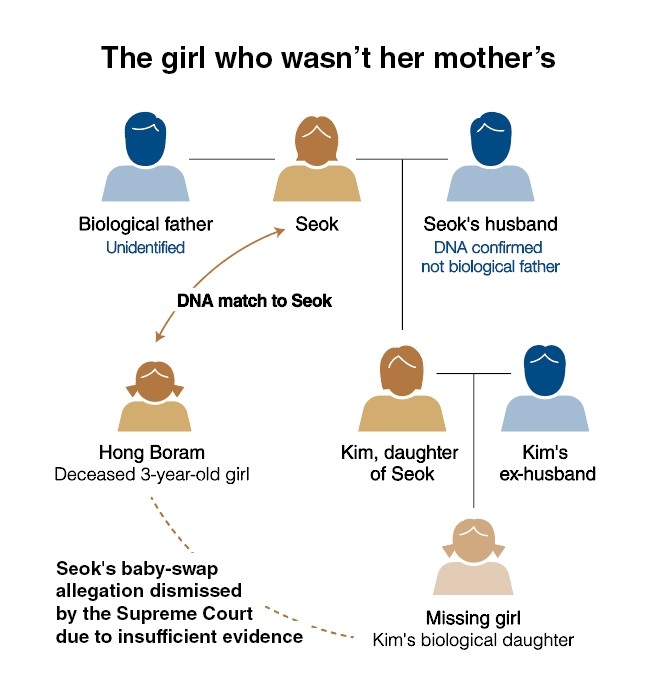
The dead girl was not Kim’s daughter.
She was Seok’s.
The National Forensic Service said the probability of a maternal relationship between Seok and the dead girl was more than 99.9999 percent. The girl’s blood type could not have been inherited from Kim and her ex-husband, meaning they could not have been her biological parents.
In other words, the child Kim had raised as her daughter was actually her half sister.
As for the girl’s biological father, DNA tests showed that neither Seok’s husband nor either of her two extramarital partners was the father.
The findings raised an obvious question: How had this happened?
Seok rejected the DNA results. She insisted that she had never given birth to the girl and had not switched her with Kim's biological daughter.
Seok’s husband told the police that he had no idea she was pregnant or that she had given birth. Kim claimed that she was not aware that the baby she was raising was not her own.
Investigators began combing through the evidence, looking for answers.
Seok had stopped buying feminine hygiene products during the period leading up to Boram's birth. Witnesses recalled that she had appeared physically different in the months before the suspected pregnancy. Her computer history at work — she did not have a computer at home — showed searches about preparing for childbirth and how to give birth alone.
Piece by piece, investigators reconstructed what they believe happened.
Seok had secretly given birth in March 2018.
On March 30, at a clinic in Gumi, Kim gave birth to a baby girl.
The next day, between 5:32 p.m. on March 31 and 8:17 a.m. on April 1, investigators believe Seok entered the clinic’s nursery.
She took Kim’s newborn daughter and removed the identification band from the baby’s right ankle. She then dressed her own newborn in the baby’s clothes and slipped the identification band inside the blanket.
She then returned her own daughter to the nursery and took Kim's baby out of the clinic to an unknown location.
The hospital’s conditions may have made such a switch possible. According to the hospital, parents could move their babies to their rooms without restriction. During the evening and overnight hours, nurses were not always present in the nursery and visited only when they were needed.
There were also clues in the hospital records.
The baby weighed 3.460 kilograms on March 31, but the next day, her weight was recorded at 3.235 kilograms. And at 5:12 p.m. on April 1, a photograph taken at the hospital showed that the identification band was no longer attached to the baby’s right ankle.
For investigators, these details helped establish when and how the two babies may have been switched.
But one question remained: Where was the other child — the baby Kim had actually given birth to?
Officials could not determine where Kim’s biological daughter was, or even whether she was still alive.
What the court could, and could not, accept
Both Seok and Kim were eventually brought to trial.
Kim faced charges including murder and child abandonment in connection with Boram’s death. For Seok, the central allegation was that she had switched the two babies.
Kim was sentenced to 20 years in prison in September 2021, with the sentence finalized after neither side appealed an appellate court's ruling. Prosecutors had sought 25 years.
In its ruling, the Daegu High Court said she “deserves stern punishment” for inflicting “unimaginable pain” on the dead child.
Seok’s trial took a different turn.
Prosecutors sought a 13-year prison sentence, describing her alleged offenses as “extremely inhumane.”
In addition to the baby-swapping allegation, Seok was charged with attempting to dispose of Boram’s body. Investigators found that she had discovered the body herself a day earlier, on Feb. 9, and allegedly attempted to dispose of it. After the attempt failed, she returned the next day with her husband.
Both lower courts recognized that Seok was the child’s biological mother and convicted her of switching the babies, accepting the prosecution’s case that she had carried out the switch. She was sentenced to eight years in prison.
In June 2022, the Supreme Court overturned the lower courts’ rulings, saying the DNA test results alone could not establish that she had switched the babies. Seok could not be held criminally liable based on the circumstantial evidence investigators had pieced together, it said.
The case subsequently returned to a lower court, which in February 2023 sentenced Seok to two years in prison, suspended for three years, for attempting to dispose of Boram’s body. She was acquitted of the baby-swapping allegation.
Remaining mysteries
In the end, the case revealed painful truths, but left other questions unresolved.
One child was abandoned and died alone. The woman who raised her was not her biological mother. And the woman identified as her biological mother continued to deny ever giving birth to her.
What remains unclear to this day is how Boram came to be raised as Kim's daughter in the first place. The baby-swapping allegation ultimately failed in court for lack of evidence, but Seok never offered an alternative explanation for how the girl came to be in Kim’s care.
Could Seok really have given birth in secret, brought the baby to the hospital and carried out the alleged switch without anyone noticing?
And where is the girl Kim actually gave birth to — and what happened to her?
More than five years later, those questions remain unanswered.
This article is a written adaptation of The Korea Herald's podcast True Crime. You can listen to the full episode on Spotify and Podbbang. ― Ed.